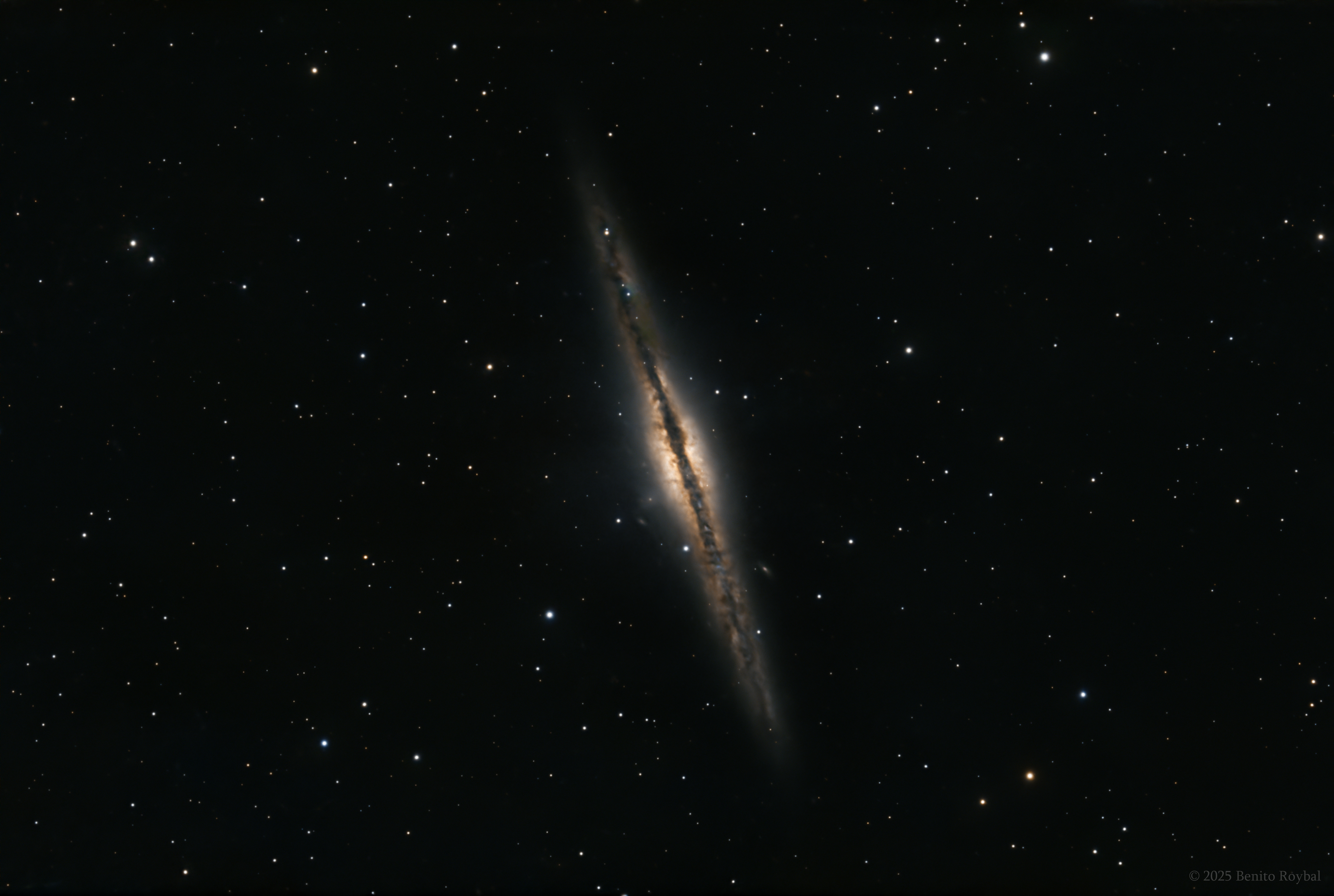
A Perfect Profile of a Spiral
Often compared to how our own Milky Way would look from the side, NGC 891 is a grand-design spiral seen exactly edge-on. Discovered by William Herschel in 1784, it is famous for its thick, opaque dust lane that appears to 'split' the galaxy in two. High-resolution images from the Hubble Space Telescope have revealed filaments of dust extending hundreds of light-years above and below the galactic plane, likely blown out by supernovae and intense star formation. It belongs to the NGC 1023 group of galaxies in the Local Supercluster.
Imaging Challenges
- • Resolving the 'fractured' nature of the dust lane, which requires steady seeing and precise focus.
- • Capturing the extremely faint stellar halo that glows softly around the sharp disk.
- • Processing the tiny background galaxies (members of the Abell 347 cluster) that often appear in the deep background near NGC 891.
NGC 891 was the first galaxy ever filmed for the opening credits of the 1960s TV show 'The Outer Limits,' earning it its popular nickname.