A Cosmic Collision of Stellar Winds
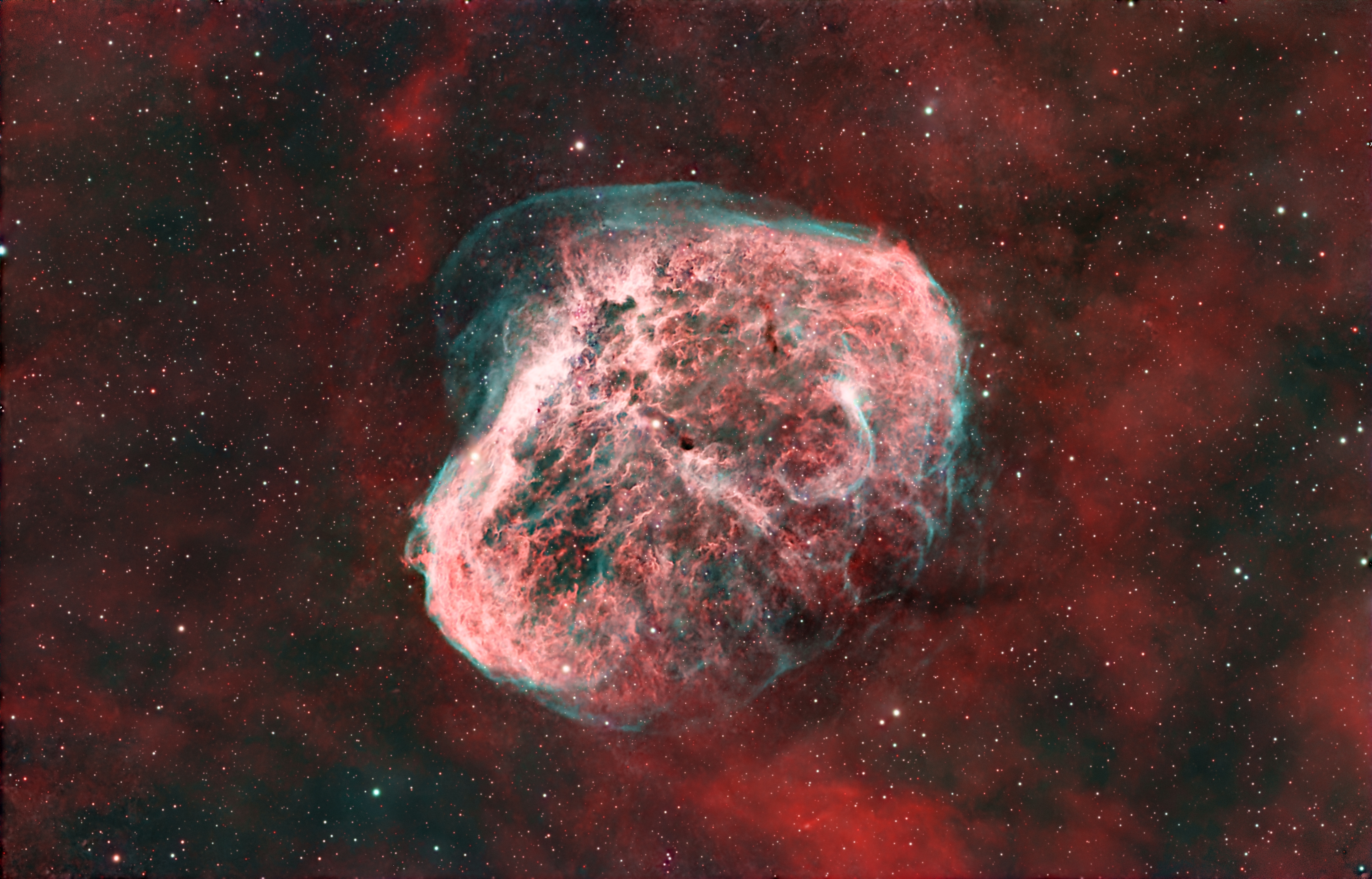

The Crescent Nebula is a cosmic collision zone. About 250,000 years ago, the central star (WR 136) shed its outer layers as it evolved into a Red Giant. Now, as a hot Wolf-Rayet star, it is blowing a much faster stellar wind. This fast wind has slammed into the slower-moving gas from the previous phase, compressing it into a complex series of shells and shockwaves that glow intensely. The intricate 'brain-like' folds are Hydrogen-alpha, while a very faint, smooth outer halo of Oxygen-III encases the entire structure.
Imaging Challenges
- • Capturing the OIII Shell: The blue Oxygen envelope is significantly fainter than the red Hydrogen core and requires many hours of integration.
- • Internal Detail: Resolving the fine, chaotic filaments inside the Crescent requires excellent deconvolution (BlurXTerminator).
- • Star Density: Like all Cygnus targets, the stars are incredibly dense and can easily hide the nebula's structure.
The central star, WR 136, is burning through its fuel so fast that it is 250,000 times brighter than our Sun and is expected to explode as a supernova in the next few hundred thousand years.