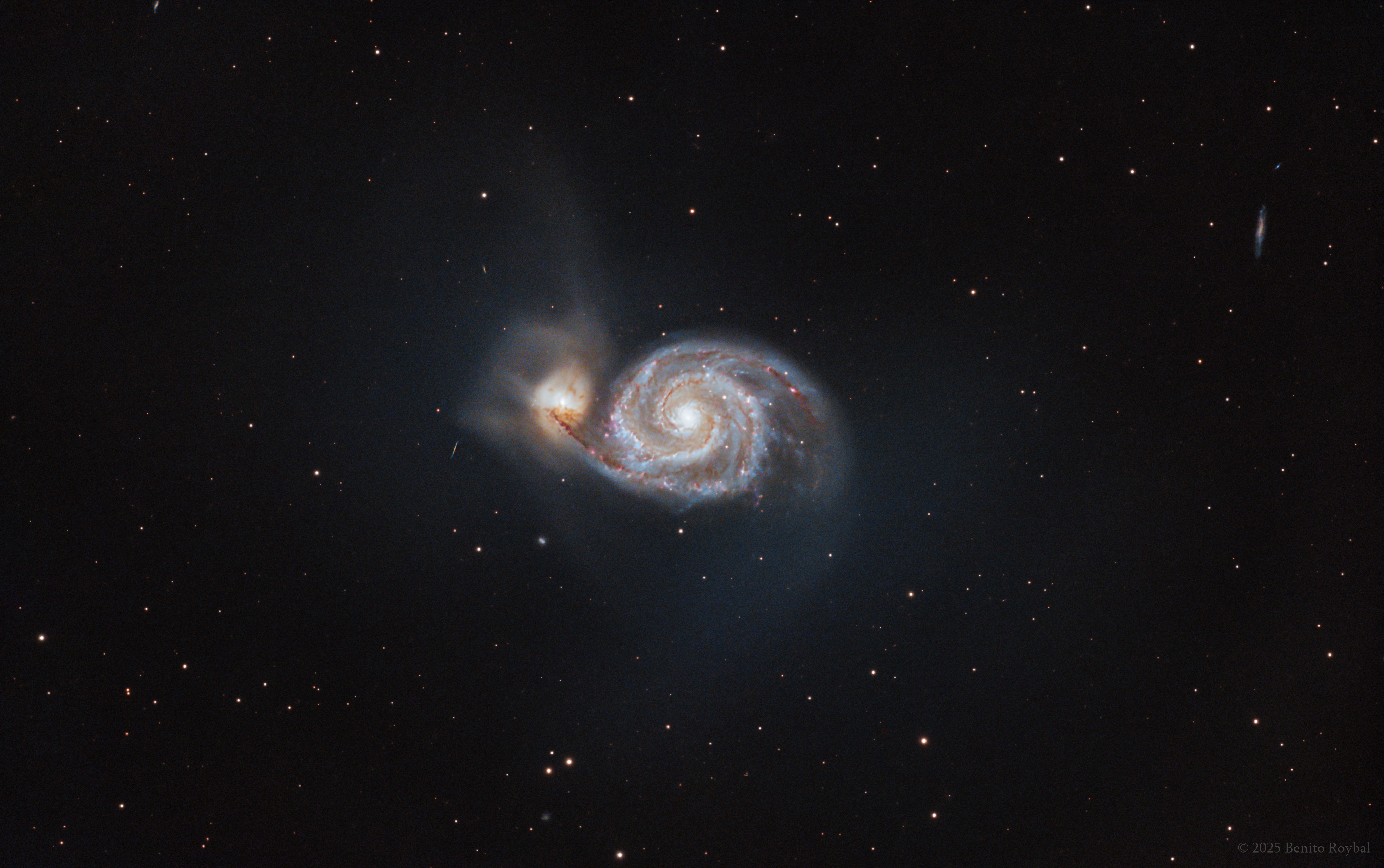
A Galactic Tug-of-War
Messier 51 was the first celestial object to be identified as having a spiral structure, observed by Lord Rosse in 1845 using the massive 'Leviathan of Parsonstown' telescope. What we see as the Whirlpool is actually two galaxies in the middle of a colossal collision. The larger spiral (NGC 5194) is using its massive gravity to pull at the smaller companion (NGC 5195). This interaction has compressed gas clouds within the spiral arms, triggering a burst of star formation—visible as bright blue star clusters and pinkish H-alpha nebulae throughout the arms.
Imaging Challenges
- • Resolving the fine dust lanes that spiral all the way into the very center of the core.
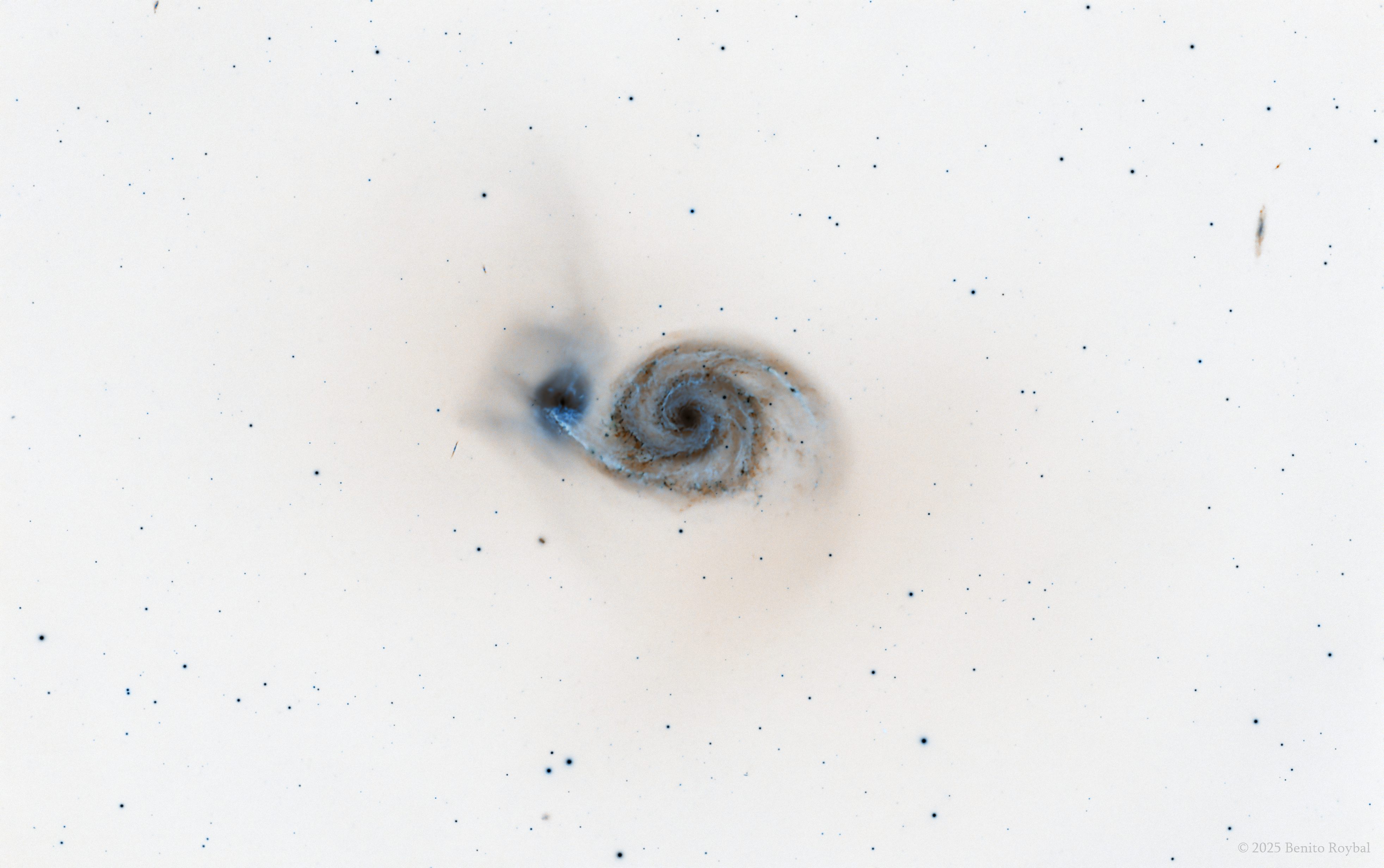
- • Capturing the faint 'stellar halo' or tidal debris that surrounds the pair, which only appears with deep integration.
- • Managing star sizes in a field that is relatively dense with foreground Milky Way stars.
The 'bridge' of stars and dust connecting the two galaxies is actually a tidal tail created by the smaller galaxy passing behind the larger one.