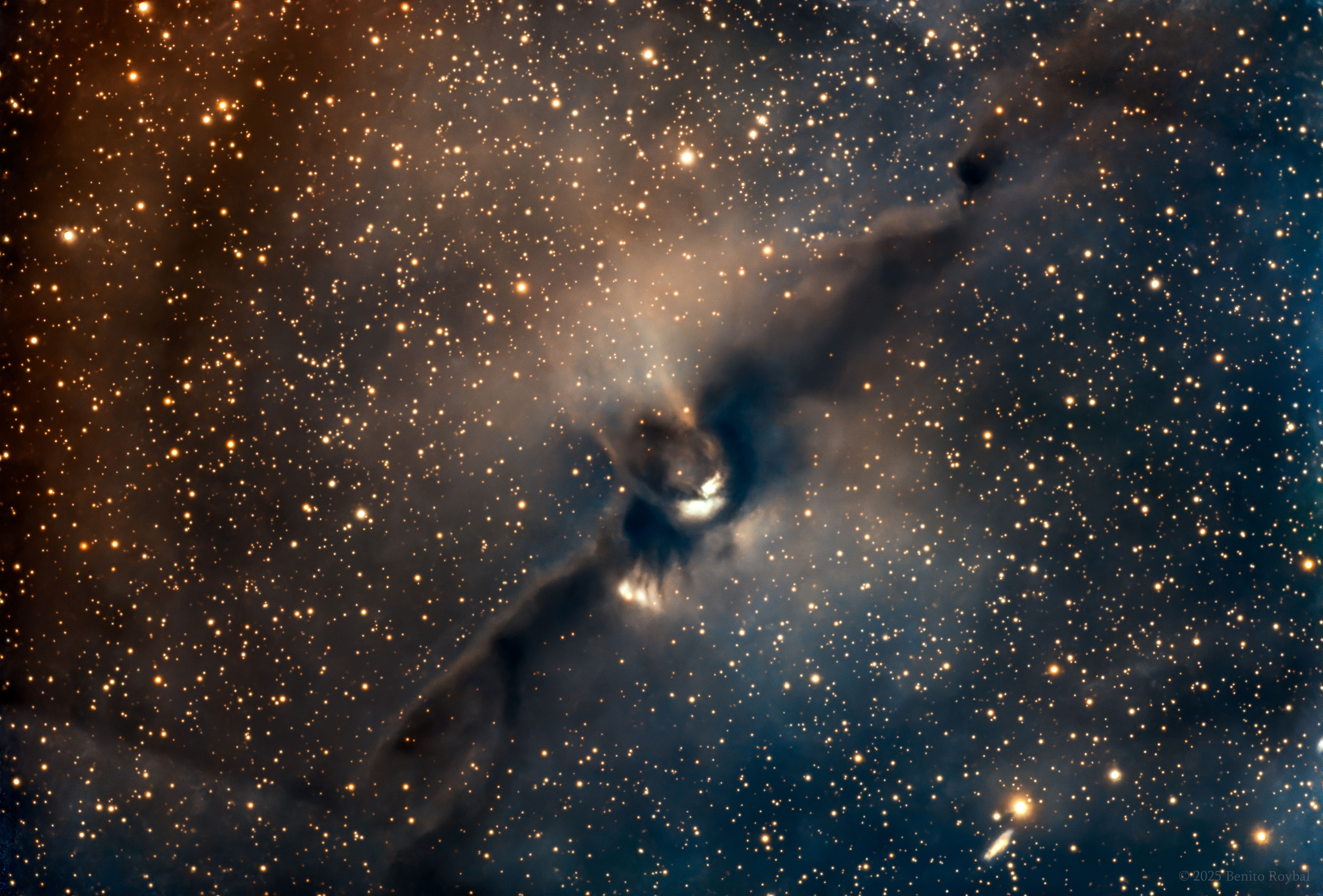

A Shadow Flying Through the Stars
LDN 43 is a dense molecular cloud of cold gas and dust. Unlike emission nebulae that glow, LDN 43 is primarily a dark nebula that blocks the light of the stars behind it. However, it is also associated with LBN 7, a faint reflection nebula. The 'Bat' shape is remarkably literal, with a distinct head and outstretched wings. Inside the 'head' of the bat, new stars are beginning to form, their light struggling to escape the thick, soot-like dust that surrounds them.
Imaging Challenges
- • Dark Sky Necessity: Because this is a dark nebula, you cannot 'filter' your way to success. You need a true Bortle 1-3 sky to capture the subtle variations in the dust density.
- • Broadband Imaging: Narrowband filters will yield almost nothing here. You must use LRGB/Broadband to capture the faint reflection component and the star colors.
- • Black Point Management: It is very tempting to clip the blacks in post-processing to hide noise, but doing so destroys the 'wispy' edges of the bat's wings.
LDN 43 is one of the closest star-forming regions to Earth, allowing us to see the 'lumpy' structure of the dust in high resolution.