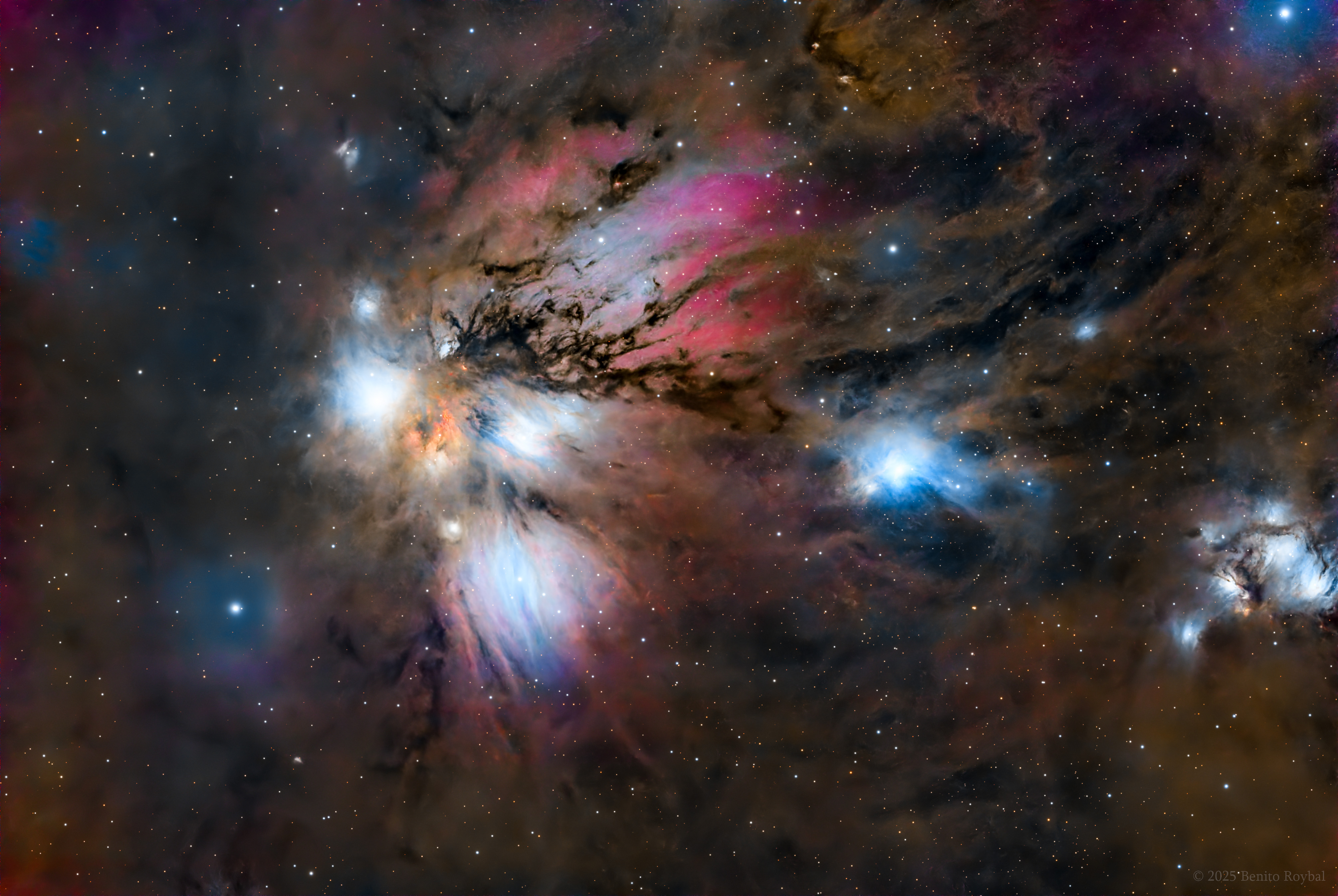

A Masterpiece of Cosmic Dust
NGC 2170 is a reflection nebula discovered by William Herschel in 1784. It is part of a massive, star-forming laboratory where hot, young stars are illuminating the dust from within. The region is famous for its color diversity: soft blue reflection nebulae, red wisps of hydrogen emission, and deep, brownish-black dust lanes. Because the dust is so thick here, it scatters light in a way that creates a 'glow' similar to a streetlamp in a thick fog, giving the entire region a soft, ethereal quality.
Imaging Challenges
- • Color Complexity: Balancing the 'cold' blues of the reflection nebula with the 'warm' browns of the dust and the 'hot' reds of the emission gas.
- • Broadband Target: This is not a narrowband target. While H-alpha helps the red wisps, the blue and brown details require pure LRGB data.
- • Deep Integration: The dust is very faint; to get that 'painterly' texture without a wall of noise, you need significant total exposure time.
Monoceros R2 is one of the closest massive star-forming regions to our solar system, providing a front-row seat to the birth of high-mass stars.