
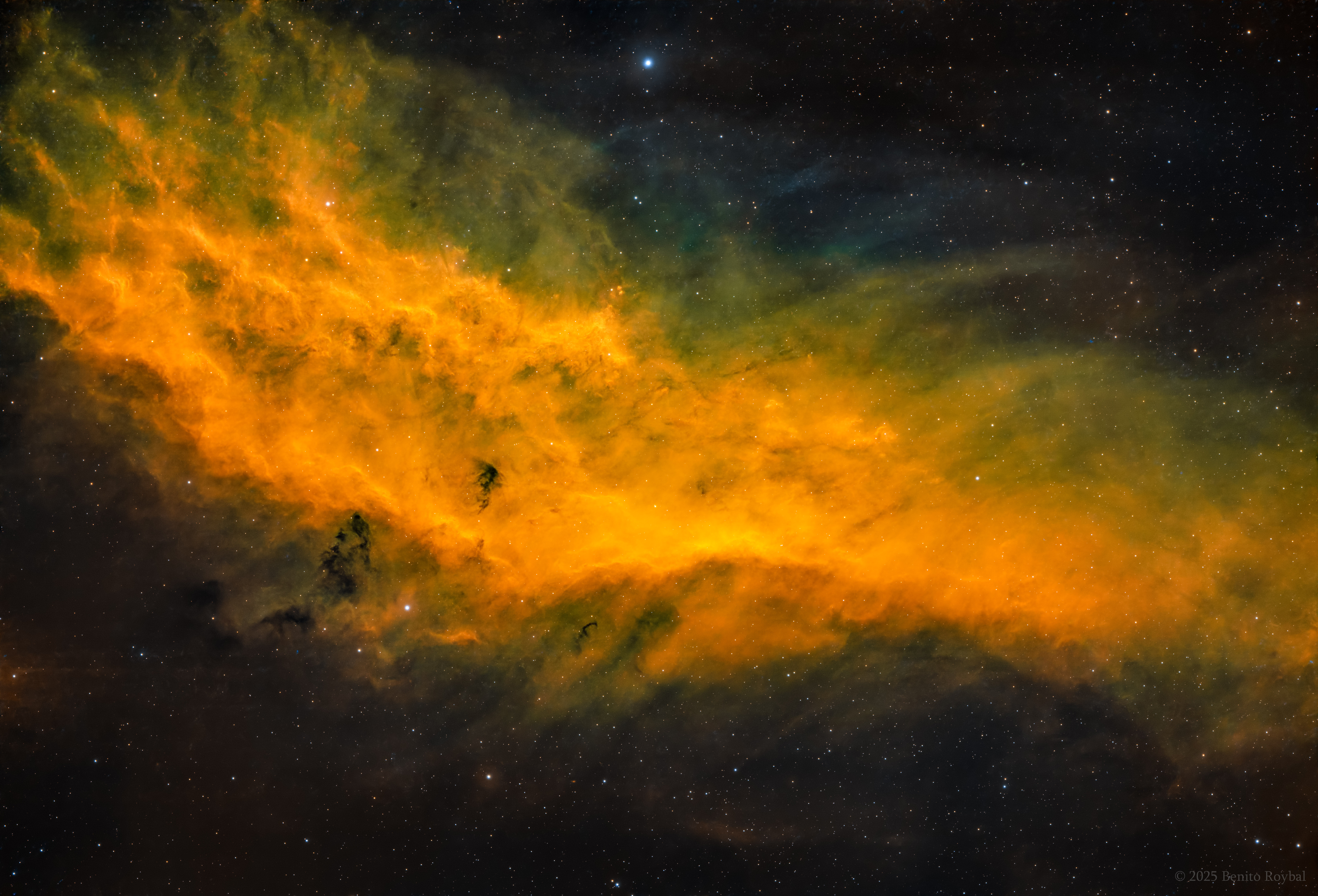
A Giant Glowing Drifter in Perseus
The California Nebula is a classic HII region located in the Perseus spiral arm of our galaxy. It is being ionized by the radiation of the nearby extremely hot, blue-white giant star, Menkhib (Xi Persei). Because the nebula is relatively close to Earth, it appears very large in the sky—nearly five times the size of the full moon. It is famous for its intricate, 'corduroy' texture of gas filaments that look like ripples in a pond, created by the intense stellar winds from Menkhib pushing through the interstellar medium.
Imaging Challenges
- • Size: Even with a wide-field scope, framing can be tight; you may need to rotate your camera to fit the 'southern' and 'northern' tips.
- • Surface Brightness: While the H-alpha signal is strong, the OIII (Oxygen) signal is famously weak and requires very deep integration to reveal.
- • Color: It is overwhelmingly red in LRGB, making it a prime candidate for narrowband processing to reveal texture.
If you were to look at the California Nebula in the sky with your eyes, you wouldn't see it—not just because it's faint, but because human eyes are poorly sensitive to the deep red H-alpha light it emits.