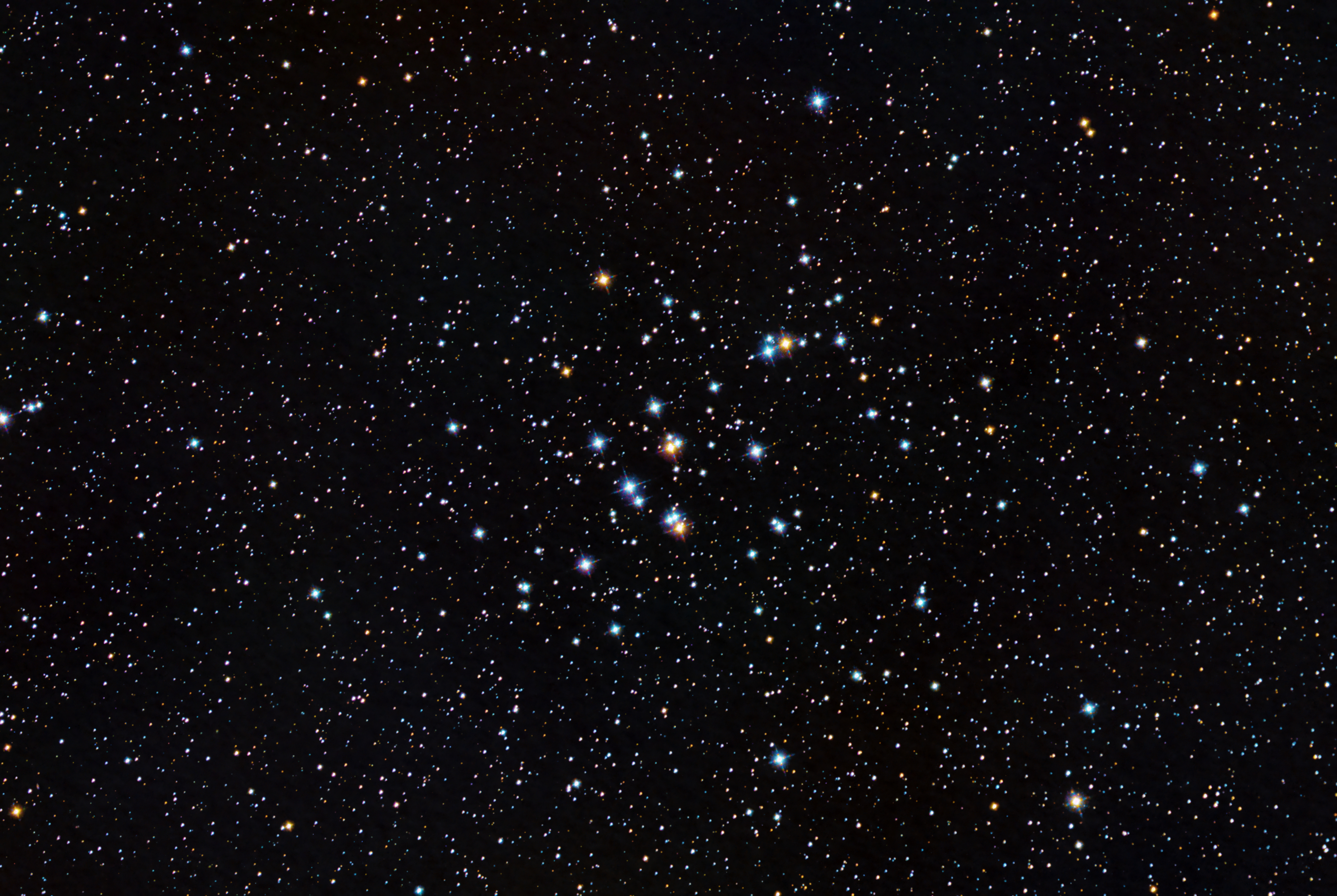

A Swarm of Ancient Sunlight
M44 is one of the oldest and largest open clusters near Earth. To the naked eye in a dark sky, it looks like a celestial 'smudge' or cloud, which led ancient astronomers like Ptolemy to describe it as a 'nebulous mass.' It contains about 1,000 stars, many of which are red giants and white dwarfs. Interestingly, M44 shares a common motion and age with the Hyades cluster in Taurus, suggesting both clusters originated from the same massive interstellar cloud of gas 600 million years ago.
Imaging Challenges
- • Star Bloat: At f/2.8, bright stars can easily become oversized. Tight focus and short exposures (or low gain) are key to keeping the 'swarm' look sharp.
- • Stellar Diversity: The cluster features a mix of hot blue stars and cool orange giants. Capturing the subtle color difference without over-saturating the sensor is the main goal.
- • Background Galaxies: Because Cancer is away from the dusty plane of the Milky Way, look for tiny, fuzzy 'stars' in your background—these are actually distant galaxies millions of light-years away.
In 2012, astronomers found two planets orbiting two different stars within M44—the first planets ever found orbiting sun-like stars in a stellar cluster.