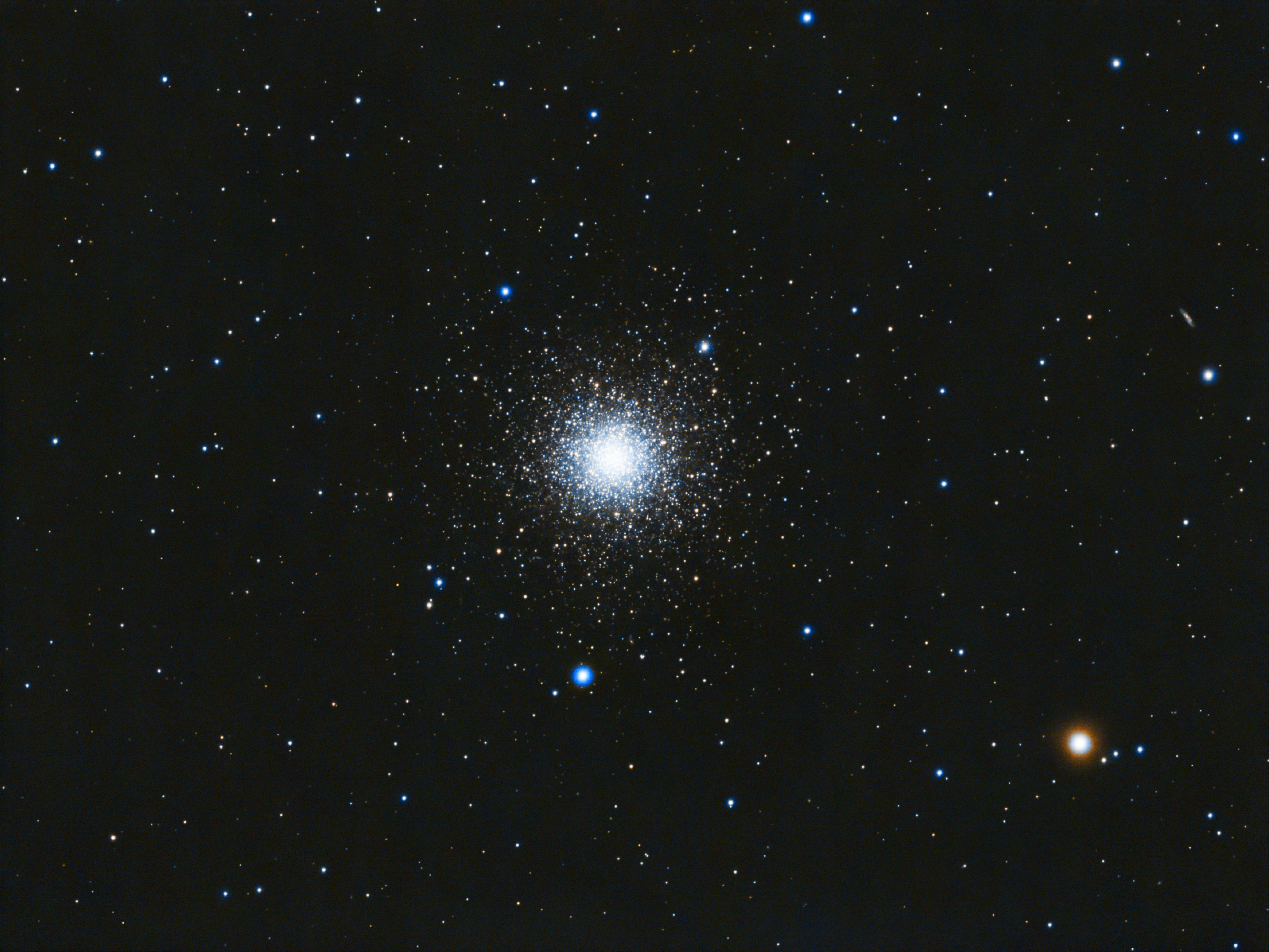
A Sparking Metropolis of Ancient Stars
Messier 3 is significant in astronomical history as it was the first object in the Messier catalog actually discovered by Charles Messier himself (M1 and M2 were previously known). Containing an incredible half a million stars, it is one of the largest and brightest globular clusters. It is also famous for its high population of variable stars, which have been instrumental in helping astronomers determine distances in the universe. Located in a relatively 'empty' part of the sky away from the Milky Way's plane, it stands out as a brilliant, isolated island of light.
Imaging Challenges
- • Resolving the outer periphery of stars which are much fainter than the blazing center.
- • Maintaining star color—M3 has a high concentration of 'Blue Stragglers' that are easy to wash out during stretching.
- • Capturing the subtle 'graininess' of the outer halo without introducing artificial noise.
M3 contains more variable stars than any other known globular cluster, with at least 274 identified to date.