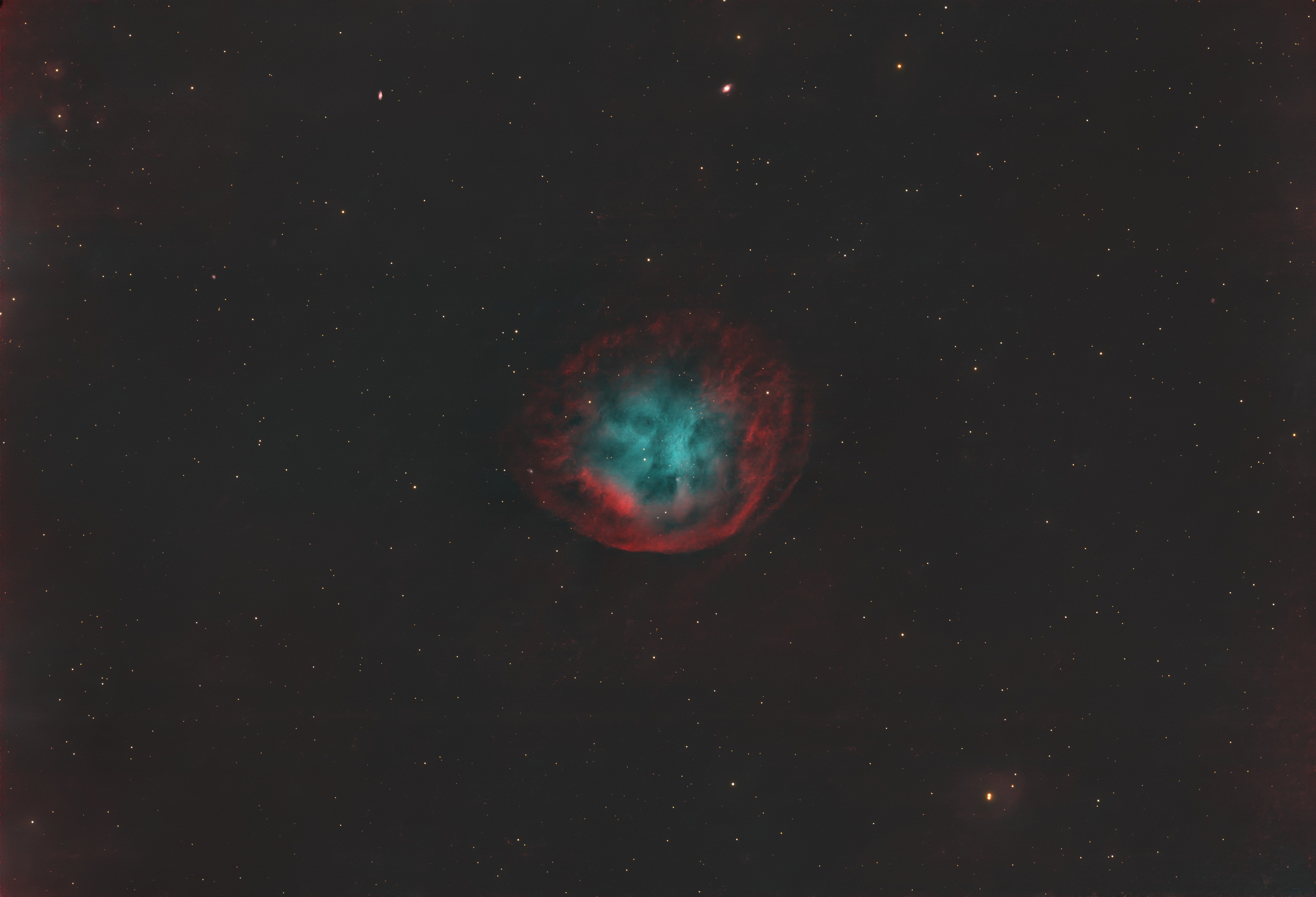

A Fading Echo of a Dead Star
Abell 31 is one of the largest and faintest planetary nebulae in the night sky, located approximately 2,000 light-years away in the constellation Cancer. Its enormous angular size is the result of an ancient stellar envelope expanding for tens of thousands of years after the death of its central star. Unlike bright, compact planetary nebulae, Abell 31 appears as a ghostly, almost invisible shell of ionized hydrogen drifting through the interstellar medium.</p> <p>This object is a challenge even for experienced astrophotographers, requiring extreme integration time and careful background extraction. Its delicate filaments and broken ring structure are best revealed in hydrogen-alpha and oxygen-III data, where faint shock fronts and fragmented arcs emerge from the noise. Abell 31 is not a showy target—it is a deep exploration of stellar death on a cosmic scale.
Imaging Challenges
- • Capturing extremely low surface brightness emission across a very large field.
- • Isolating nebular signal from strong background gradients.
- • Revealing structure without introducing processing artifacts.
- • Requires long integration and precise narrowband filtering.