The Pulse of the Perseus Arm
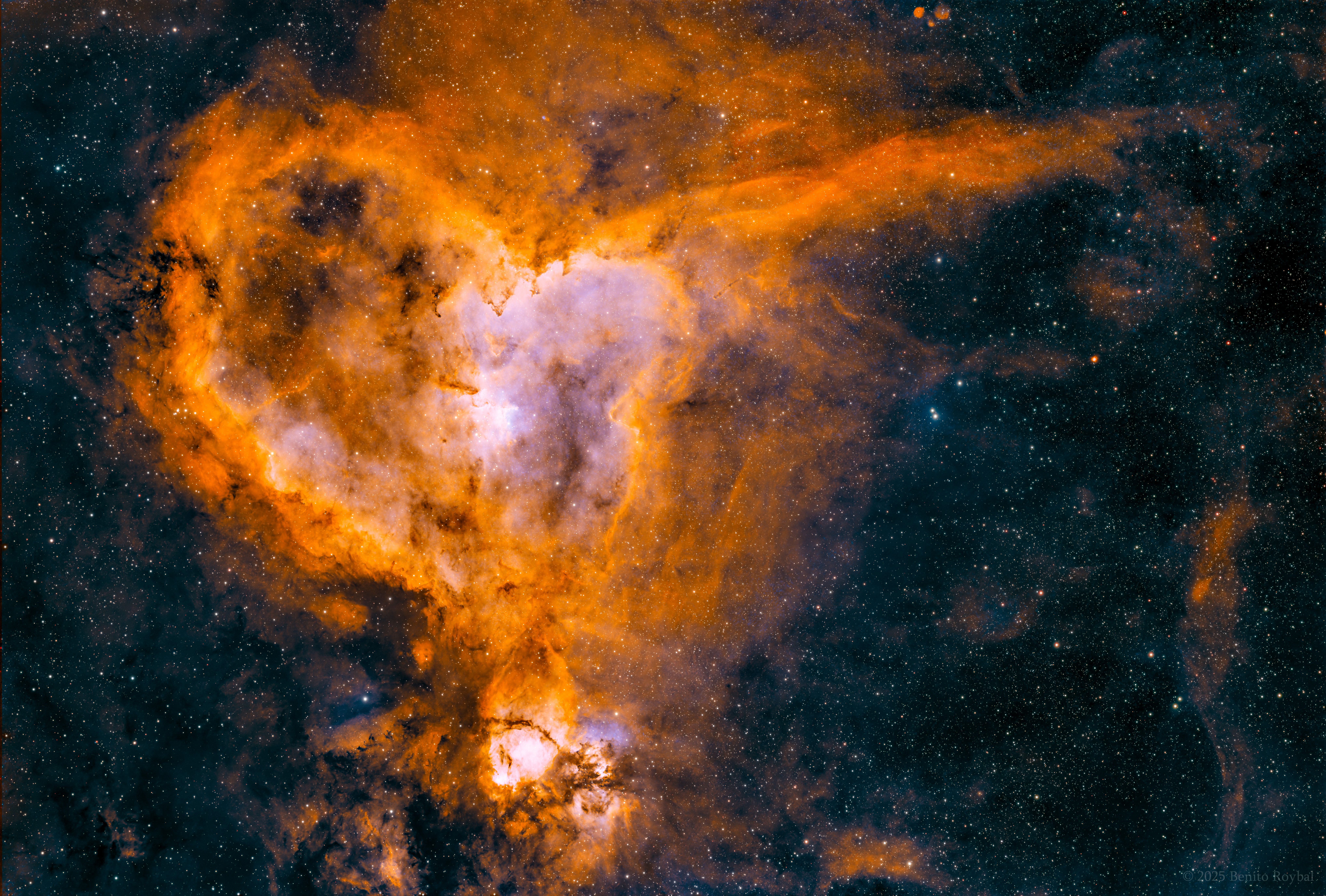
Spanning nearly 200 light-years, IC 1805 is a massive complex of glowing interstellar gas and dark dust clouds. Located in the constellation Cassiopeia, its distinctive shape has earned it the name the Heart Nebula.
At the core of the nebula lies Melotte 15, a small open cluster of stars about 1.5 million years young. These massive stars are roughly 50 times the mass of our Sun and are the "engine" of the nebula; their intense radiation and stellar winds sculpt the surrounding hydrogen gas into the towering pillars and deep canyons captured in this portrait.
Imaging Challenges
- Melotte 15 Detail: The central core is the most intricate part of the nebula. Resolving the 3D-like structures of the dust pillars requires high-resolution imaging and expert sharpening techniques.
- Narrowband Balancing: To achieve a rich palette, Sulfur-II, Hydrogen-Alpha, and Oxygen-III must be carefully blended to highlight the chemical composition of the gas clouds.
- Massive Field of View: The Heart is a huge target. Capturing the entire structure requires either a wide-field telescope or a multi-panel mosaic, adding layers of complexity to the acquisition.
"The Heart Nebula is a cosmic nursery where the light of newborn stars literally pushes back the darkness, carving a silhouette of life-giving warmth against the cold of space."