
A Cosmic Collision in Slow Motion
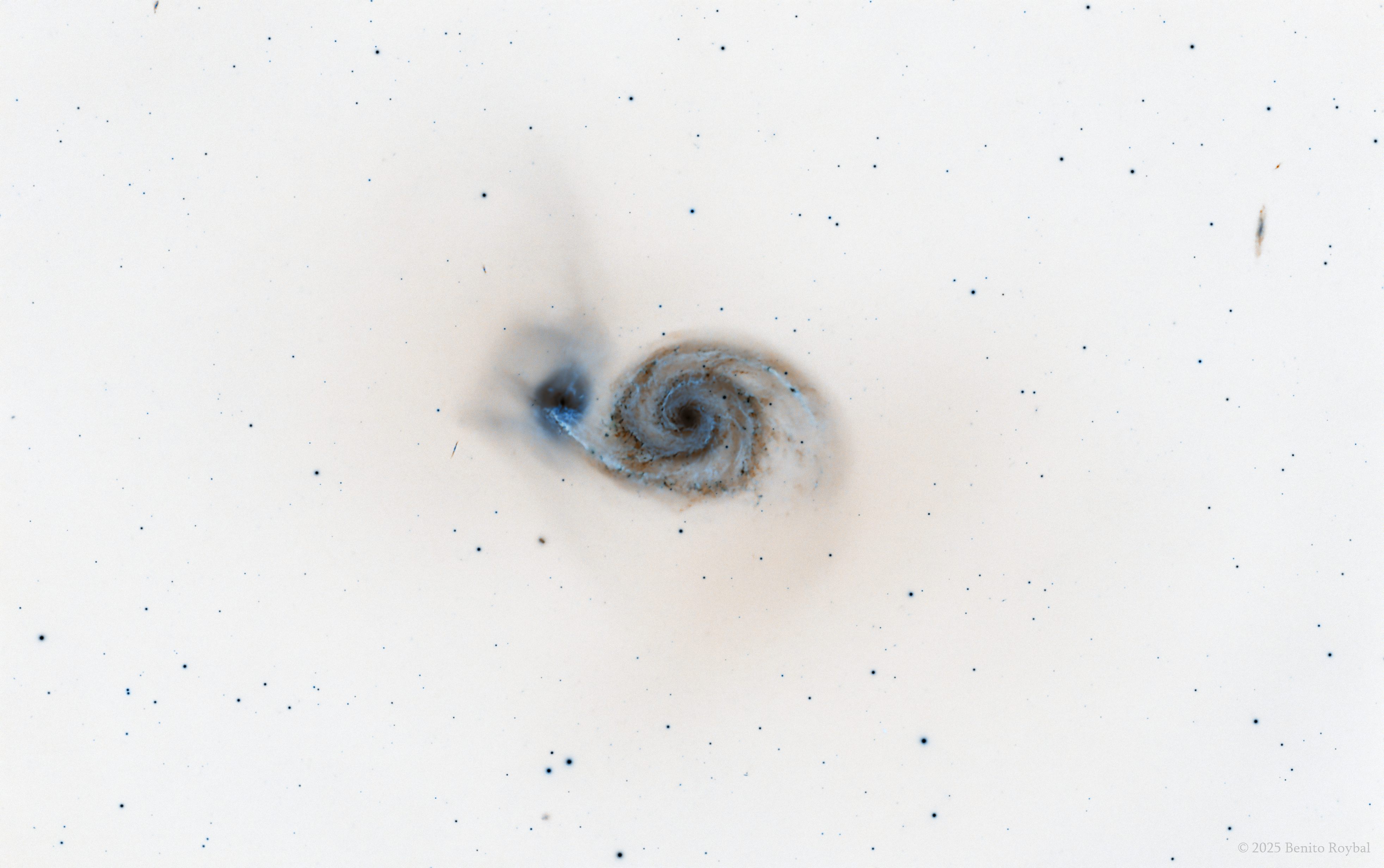
Located 31 million light-years away in Canes Venatici, M51 is the quintessential example of a "Grand Design" spiral galaxy. Its face-on orientation and dramatic interaction with its companion, NGC 5195, make it one of the most studied objects in the heavens.
The interaction between the two galaxies is more than just visual. The gravitational pull of the smaller companion acts like a massive spoon, "stirring" the gas and dust in the larger spiral. This compression triggers massive waves of star formation, visible in this image as bright pink HII regions and brilliant blue star clusters that define the sweeping arms.
Imaging Challenges
- Interacting Dust: The "bridge" between the two galaxies is rich in fine dust filaments. Resolving these without over-processing the core requires a delicate touch with deconvolution.
- Tidal Tails: Very deep integration reveals faint "tidal tails"—ghostly streams of stars pulled out of the galaxies during their close encounter. These require a dark sky and high Signal-to-Noise ratio.
- Dynamic Core: The core of M51 is extremely bright compared to its outer arms. Using HDR composition helps preserve the detail of the central black hole region while showing the faint extremities.
"M51 is a snapshot of gravity's raw power. It is a reminder that on a galactic scale, even a collision can create a masterpiece of structure and light."